Showing posts with label sugar. Show all posts

Friday, July 20, 2012

Six Surprising Foods with More Sugar than a Twinkie

By Dr. Mercola
Of all the foods capable of inflicting damage in your body, sugar is one of the most damaging of all.Sugar, and the type of sugar known as fructose, in particular, is an extremely potent pro-inflammatory agent that creates advanced glycation end products (AGEs) and speeds up the aging process.
It also promotes the kind of dangerous growth of fat cells around your vital organs which is the hallmark of diabetes and heart disease.
Sugar also increases your insulin and leptin levels and decreases receptor sensitivity for both of these vital hormones, and this is another major factor of premature aging and age-related chronic degenerative diseases such as heart disease, as well as a leading cause of the climbing rates of overweight and obesity in developed countries.
That sugar is bad for your health is probably old news to you by now, but what may surprise you is just how much sugar is lurking in foods that are often passed off as "healthy."
Many supposedly "good for you" foods have more sugar than a Twinkie!

Are You Eating These Sugar-Laden "Health" Foods?

The Huffington Post recently outed several foods that are so high in sugar, you may as well be eating a candy bar. All of these also have more sugar than a Twinkie …
  • Yogurt: Most commercial yogurt is loaded with sugar – as in, over 30 grams for 6 ounces! This, along with the fact that commercial yogurt is pasteurized (and some also contains artificial colors and flavors), is why you should walk right on by the yogurt section at your supermarket. Watch out, too, for "light" yogurt brands that boast less sugar due to toxic artificial sweeteners.
  • On the other hand, yogurt that is made from raw organic milk, and which you eat either plain or only minimally sweetened with some berries or liquid stevia, is a true health food. This is something you can easily do at home and use the healthiest raw ingredients, including organic grass-fed raw milk as the starter.
  • Tomato Sauce: A cup of tomato sauce can add up to over 20 grams of sugar, and considering that most people eat that tomato sauce on top of pasta, another carb source, this could send you into sugar overload. Watch out, specifically, for brands that contain added sweeteners. Tomato sauce is a far better choice than a candy bar, but, ideally, make your own sauce at home, and serve it over shredded spaghetti squash instead of noodles.
  • Granola Bars: Sugar is often one of the top ingredients in granola bars, and, in fact, most are not much different than a candy bar, nutritionally speaking. Even the granola is simply another form of "hidden sugar" that most people eat far too much of. Remember, sugar and dietary carbohydrates (including grains like granola, which break down into sugar) lead to excess body fat, obesity and related health issues. No amount of exercise can compensate for this damage because if you eat a lot of sugar, it could be "reprogramming" your body to become fat.
  • Fat-Free Salad Dressing: When manufacturers take the fat out of a food, sugar is often added back in as a replacement. Fat-free French or Thousand Island dressings can contain over 40 grams of sugar as a result, turning a would-be healthy salad into something more resembling a dessert. Don't be fooled by the "fat-free" label -- it's the carbs that are the culprit in weight gain and chronic disease.
  • Muffins: The high amount of carbs in most muffins will profoundly interfere with your leptin and insulin levels, and that is true even if it's a "healthy" muffin, like a bran muffin. Of course, in order to make a bran muffin palatable, it probably contains quite a bit of added sugar, on top of the grains it's made with. Many muffins are also jumbo-sized, easily packing over 30 grams of sugar, or more.
  • Canned Fruit: Fruit in and of itself can be problematic if eaten in excess, as it's a source of naturally occurring fructose. But many canned fruits are also packed in sugary syrup, loaded with high fructose corn syrup. Just one cup of canned peaches or pears can contain over 30 grams of sugar. You're far better off with a fresh piece of fruit instead, but use moderation. I recommend restricting your consumption of fructose to no more than 25 grams per day, with a maximum of 15 grams a day from fresh fruit. If you're already overweight, or have cancer, heart disease or diabetes (or are at high risk of them), then you're probably better off cutting that down to 10-15 grams per day -- fruit included. 

Why a High-Sugar Diet Will Make You Fat

If you are seeking to lose weight and optimize your health, foods that contain added sugar, as well as grains like bread and pasta should be eliminated or else comprise very low percentages of your diet. Most people who bought into the "high-carb, low-fat" dietary recommendations has likely struggled with their weight and health, wondering what they're doing wrong.
The problem is that overeating carbohydrates can prevent a higher percentage of fats from being used for energy, and lead to an increase in fat production and storage. Your body has a limited capacity to store excess carbohydrates. This is one of the reasons why elevated blood sugar follows their overconsumption. If you are not able to immediately use the sugar as a result of intense physical activity then one of the ways your body avoids dangerously elevated blood sugar is through converting those excess carbohydrates into excess body fat primarily in your belly.
The way it works is that any carbohydrates not immediately burned by your body as fuel are stored in the form of glycogen (a long string of glucose molecules linked together). Your body has two storage sites for glycogen: your liver and your muscles. Once the glycogen levels are filled in both your liver and muscles, excess carbohydrates are converted into fat and stored in your adipose, that is, fatty tissue.
So, although carbohydrates are "fat-free," this is misleading because excess carbohydrates end up as excess fat. When you see refined grains on a food label, think of them as "hidden sugar," and when you see sugar, think of it as "hidden fat."
But that's not the worst of it.
Any meal or snack high in "complex" carbohydrates, i.e. starch is actually a complex of glucose molecules, will also generate a rapid rise in blood glucose. To adjust for this rapid rise, your pancreas secretes insulin, which then lowers your levels of blood glucose. The problem is that insulin is essentially a storage hormone, evolved to put aside excess carbohydrate calories in the form of fat in case of future famine. So the insulin that's stimulated by excess carbohydrates aggressively promotes the accumulation of body fat! This was enormously useful in ancient times when calories were frequently scarce, but today this setup is a disaster waiting to happen.
In other words, when you eat too much sugar, bread, pasta, and any other grain products, you're essentially sending a hormonal message, via insulin, to your body that says "store more fat."  This is actually a highly beneficial response in certain scenarios such as when calories are very scarce. This provides a major survival advantage -- but for nearly everyone reading this, having insufficient calories is not an issue, so this protective mechanism actually sabotages your health.
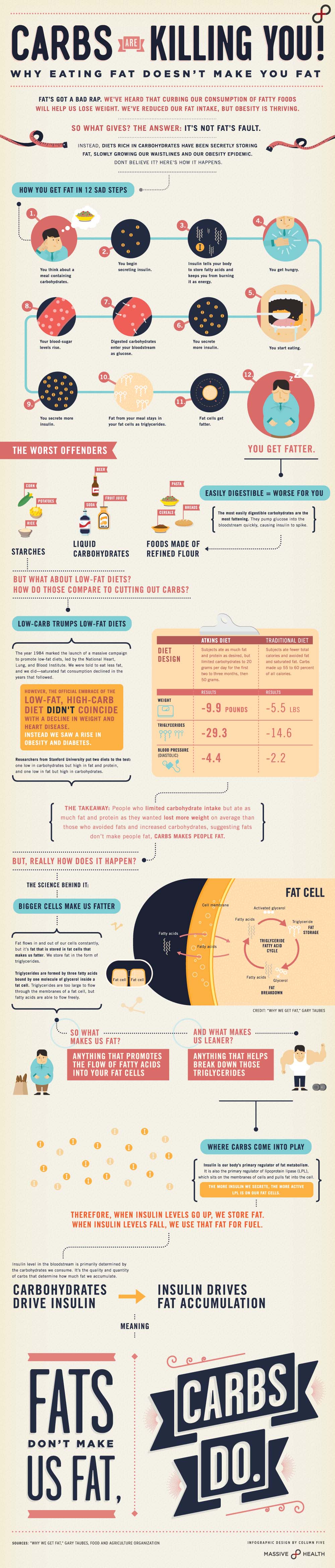
If you're having trouble getting your mind around this, a wonderful infographic created by Column Five for Massive Health, based on Why We Get Fat by science writer Gary Taubes, explains exactly why eating fat doesn't make you fat -- but eating carbs like sugar can kill you …
IMAGE COURTESY OF MASSIVE HEALTH. READ ABOUT THIS INFOGRAPHIC
Is It Possible to Cut Out Dietary Sugar and Still Feel Satisfied?

Based on USDA estimates the average American consumes 12 teaspoons of sugar a day, which equates to about TWO TONS of sugar during a lifetime. Why we eat this much sugar is not difficult to understand -- it tastes good, and it gives us pleasure by triggering an innate process in your brain via dopamine and opioid signals.
What it is doing to us on both a physical and emotional level is another story entirely, and most people stand to reap major improvements in their health by cutting back on, or eliminating, sugar altogether from their diets. Many do not realize this, but frequent hunger may be a major clue that you're not eating correctly. Your body needs fuel regularly and if you don't provide it with the proper amounts of fats and protein and overload on sugars, you will not fill your energy reserves properly. This sets up a vicious cycle of cravings for the sugar that will solve the problem in the short run but serve to radically shorten your life in the long term.
Just remember that your body is very intelligent and only seeking to keep you alive and healthy. The cravings are its short-term solution to keep you alive and functioning. But you need to exert some higher order cognitive skills to understand how to shift out of carb burning and into a fat-burning machine. Fat is far more satiating than carbs, so if you have cut down on sugar and feel ravenous, thinking you "can't do without the carbs," remember this is a sign that you haven't replaced them with sufficient amounts of fat. So go ahead and add a bit more healthy fats from the list below:
Olives and Olive oil Coconuts and coconut oil Butter made from raw grass-fed organic milk
Raw nuts, such as, almonds or pecans Organic pastured egg yolks Avocados
Grass-fed meats Palm oil Unheated organic nut oils

According to experts, carbs should ideally make up 20-30 percent of your diet, while 50-70 percent of your diet should be healthy fats. While many can appear to be healthy on vastly different ratios it is best to examine the long-term consequences of veering far from these ratios when deciding if they make sense to follow for you personally.
In order to achieve this and minimize your sugar intake, you need to avoid most processed foods, as even savory foods like salad dressing, soup, and bread often contain added sugar. For optimal health, eat natural whole foods primarily, and limit your fructose consumption to below 25 grams per day. If you still want to use a sweetener occasionally, the sweet herb stevia makes a good sugar substitute. (Avoid ALL artificial sweeteners, which can damage your health even more quickly than sugar.)

How to Kick Your Sugar Addiction to the Curb

If you're struggling with sugar addiction and having trouble dealing with cravings, I highly recommend trying an energy psychology technique called Turbo Tapping, which has helped many "soda addicts" kick their sweet habit, and it should work for any type of sweet craving you may have. A couple of other tricks to try to kick your sugar cravings:
  • Exercise: Anyone who exercises intensely on a regular basis will know that significant amounts of cardiovascular exercise is one of the best "cures" for food cravings. It always amazes me how my appetite, especially for sweets, dramatically decreases after a good workout. I believe the mechanism is related to the dramatic reduction in insulin levels that occurs after exercise.
  • Organic, black coffee: Coffee is a potent opioid receptor antagonist, and contains compounds such as cafestrol -- found plentifully in both caffeinated and decaffeinated coffee -- which can bind to your opioid receptors, occupy them and essentially block your addiction to other opioid-releasing foods.i ii This may profoundly reduce the addictive power of other substances, such as sugar.
References:

Sources:

Thursday, January 12, 2012

Why McDonald's Happy Meal hamburgers won't decompose - the real story behind the story

It's always entertaining when the mainstream media "discovers" something they think is new even though the natural health community has been talking about for years. The New York Times, for example, recently ran a story entitled When Drugs Cause Problems They Are Supposed to Prevent (http://www.nytimes.com/2010/10/17/h...). We've been covering the same topic for years, reporting on how chemotherapy causes cancer, osteoporosis drugs cause bone fractures and antidepressant drugs cause suicidal behavior.

The latest "new" discovery by the mainstream media is that McDonald's Happy Meal hamburgers and fries won't decompose, even if you leave them out for six months. This story has been picked up by CNN, the Washington Post and many other MSM outlets which appear startled that junk food from fast food chains won't decompose.

The funny thing about this is that the natural health industry already covered this topic years ago. Remember Len Foley's Bionic Burger video? It was posted in 2007 and eventually racked up a whopping 2 million views on YouTube (http://www.youtube.com/watch?v=mYyD...). And this video shows a guy who bought his McDonald's hamburgers in 1989 -- burgers that still haven't decomposed in over two decades!

Now, he has an entire museum of non-decomposed burgers in his basement.

Did the mainstream media pick up on this story? Nope. Not a word. The story was completely ignored. It was only in 2010 when an artist posted a story about a non-decomposing McDonald's hamburger from six months ago that the news networks ran with the story.

Check out the video link above and you'll see an entire museum of Big Macs and hamburgers spanning the years -- none of which have decomposed.

This is especially interesting because the more recent "Happy Meal Project" which only tracks a burger for six months has drawn quite a lot of criticism from a few critics who say the burgers will decompose if you give them enough time. They obviously don't know about the mummified burger museum going all the way back to 1989. This stuff never seems to decompose!

Why don't McDonald's hamburgers decompose?

So why don't fast food burgers and fries decompose in the first place? The knee-jerk answer is often thought to be, "Well they must be made with so many chemicals that even mold won't eat them." While that's part of the answer, it's not the whole story.

The truth is many processed foods don't decompose and won't be eaten by molds, insects or even rodents. Try leaving a tub of margarine outside in your yard and see if anything bothers to eat it. You'll find that the margarine stays seems immortal, too!

Potato chips can last for decades. Frozen pizzas are remarkably resistant to decomposition. And you know those processed Christmas sausages and meats sold around the holiday season? You can keep them for years and they'll never rot.

With meats, the primary reason why they don't decompose is their high sodium content. Salt is a great preservative, as early humans have known for thousands of years. McDonald's meat patties are absolutely loaded with sodium -- so much so that they qualify as "preserved" meat, not even counting the chemicals you might find in the meat.

To me, there's not much mystery about the meat not decomposing. The real question in my mind is why don't the buns mold? That's the really scary part, since healthy bread begins to mold within days. What could possibly be in McDonald's hamburger buns that would ward off microscopic life for more than two decades?

As it turns out, unless you're a chemist you probably can't even read the ingredients list out loud. Here's what McDonald's own website says you'll find in their buns:

Enriched flour (bleached wheat flour, malted barley flour, niacin, reduced iron, thiamin mononitrate, riboflavin, folic acid, enzymes), water, high fructose corn syrup, sugar, yeast, soybean oil and/or partially hydrogenated soybean oil, contains 2% or less of the following: salt, calcium sulfate, calcium carbonate, wheat gluten, ammonium sulfate, ammonium chloride, dough conditioners (sodium stearoyl lactylate, datem, ascorbic acid, azodicarbonamide, mono- and diglycerides, ethoxylated monoglycerides, monocalcium phosphate, enzymes, guar gum, calcium peroxide, soy flour), calcium propionate and sodium propionate (preservatives), soy lecithin.

Great stuff, huh? You gotta especially love the HFCS (diabetes, anyone?), partially-hydrogenated soybean oil (anybody want heart disease?) and the long list of chemicals such as ammonium sulfate and sodium proprionate. Yum. I'm drooling just thinking about it.

Now here's the truly shocking part about all this: In my estimation, the reason nothing will eat a McDonald's hamburger bun (except a human) is because it's not food!

No normal animal will perceive a McDonald's hamburger bun as food, and as it turns out, neither will bacteria or fungi. To their senses, it's just not edible stuff. That's why these bionic burger buns just won't decompose.

Which brings me to my final point about this whole laughable distraction: There is only one species on planet Earth that's stupid enough to think a McDonald's hamburger is food. This species is suffering from skyrocketing rates of diabetes, cancer, heart disease, dementia and obesity. This species claims to be the most intelligent species on the planet, and yet it behaves in such a moronic way that it feeds its own children poisonous chemicals and such atrocious non-foods that even fungi won't eat it (and fungi will eat cow manure, just FYI).

Care to guess which species I'm talking about?

Sunday, January 01, 2012

Franken-Food Additives Poisoning the Masses


Our ancestors used salt to preserve meats and fish, added herbs and spices to sharpen the flavor of foods, preserved fruit with sugar, and pickled cucumbers in vinegar. They also had their own gardens, raised their own livestock, ate local and in season. However, they were not eating the Franken-foods of today, including genetically modified food, chemically preserved food, flavor “enhanced” food, sugar filled food, fortified food and hormone injected food. They certainly weren’t eating processed foods, filled with additives and stripped of nutrients. I think it’s safe to assume that they ate much better than we do today. How backwards have we gone that we now must pay more money for organic, chemical free and hormone free food? Who are these psychopaths coming up with the ideas to modify and poison our food? The FDA and the EFSA cannot be trusted. They lie. They don’t care about you.

Did you know that many retired FDA officials go to work as special advisors to the pharmaceutical and food industries? Federal agencies like the FDA, which were created to protect consumers, often behave like branch offices of companies like Monsanto, which they are supposed to regulate. We should all know about the horror of Monsanto by now.

The FDA approved irradiated foods, which become radioactive as a result of processing. Dr. Gayle Eversole says, “Food irradiation exposes food to the equivalent of 30 million chest X-rays. Irradiation creates new chemicals in foods called radiolytic products. Some of these products are known cancer-causing substances (like benzene in irradiated beef). Others are unique to the irradiation process and no one knows what effects these have on human health. Irradiation destroys essential vitamins and nutrients that are naturally present in food. No studies have been done to show that a long-term diet of irradiated foods is safe. Safer, well-tested alternatives to irradiation exist.” Wow, what an amazing breakthrough FDA! You sure care about us and the environment. Yet they’ll go on hiding under the cloak of concern and safety for the public.

The FDA has no definition for “natural” used on food labels and continues to be extremely sinister and sneaky by labeling MSG under many obscure names. Why? These people are psychotic and want to poison the masses.

The European Food Safety Authority isn’t off the hook either. According to the candid confession of Dr. Herman Koeter, former EFSA director who resigned in 2008, the EFSA was about to announce to the world that aspartame is a deadly neurotoxin, unsafe for humans in any form. But eleven of the “experts” had connections with the aspartame industry. Somehow the evidence was “lost.” EFSA declared this chemical poison is safe as rain. Safe for babies, safe for children, safe for pregnant mothers, safe for diabetics, safe for everybody! Excellent work EFSA! You really care about what matters most.

This article is intended to bring awareness about dangerous food additives. Like in the 1985 movie Brazil, where everyone orders food according to a number, instead of saying what it is, it doesn’t seem so far off from food labeling today.

If you live in the European Union, you’ve probably noticed the letter E followed by a number on a label of a food item. This identifies food additives (e.g., sweeteners, preservatives, stabilizers). Additives receive an E number (E for Europe), simplifying communication about food additives in the list of ingredients across the different languages of the EU. E-numbers are also encountered on food labeling in other jurisdictions, including the Cooperation Council for the Arab States of the Gulf, Australia, New Zealand and Israel. They are increasingly, though still rarely, found on North American packaging, especially in Canada on imported European products.

It’s time to become a hawk reading food labels at the grocery store. Your physical body, mind and soul depend upon it.

If you live in the EU, you’ll see hundreds of different E-numbers. Most are toxic and will make you sick in time. Only eat from the following below, which come from natural sources. We’ll agree that the definition of natural is, produced by nature. (It was a shorter list to note the ok’s vs. the bad. For the USA list scroll down.)

NumberNameComment
E100CurcuminDerived from the root of the curcuma (turmeric) plant, but can be artificially produced; used in cheese, margarine, baked sweets
E101Riboflavin Occurs naturally in green vegetables, eggs, milk, liver and kidney; used in margarine and cheese
E101aRiboflavin-5’-phosphateOccurs naturally in green vegetables, eggs, milk, liver and kidney; used in margarine and cheese
E150aCaramelDark brown color derived from sucrose; Used in soft drinks; oyster, soy, fruit and canned sauces; beer, whiskey, biscuits and pickles.
E160aCaroteneOrange-yellow colour; human body converts it to ’Vitamin A’ in the liver, found in carrots and other yellow or orange fruits and vegetables
E160dLycopeneRed coloured carotenoid found in tomatoes and pink grapefruit, can cause decreasing risk
of cancer
E160eBeta-apo-8’-carotenal (C 30)Orange color, no adverse effects are known
E160fEthyl ester of beta-apo-8’-carotenic acid (C30)Orange color, no adverse effects are known
E161bLuteinYellow color derived from plants, naturally found in green leaves, marigolds and egg yolks
E161gCanthaxanthinYellow color possibly derived from animal sources (retinol); the pigment is found in some mushrooms, crustacea, fish, flamingo feathers
E162Beetroot RedPurple color derived from beets; no adverse effects are known
E163AnthocyaninsViolet color matter of flowers and plants
E170Calcium carbonateMineral salt, used in toothpastes, white paint and cleaning powders; may be derived from rock mineral or animal bones; sometimes used to deacidify wines and firm canned fruit and veg.; toxic at ’high doses’
E171Titanium dioxideWhite color used in toothpaste and white paint, pollutes waterways; no adverse effects are known
E172Iron oxides and hydroxidesBlack, yellow, red color used in salmon and shrimp pastes; toxic at ’high doses’
E181Tannic acidTannins, clarifying agent in alcohol; derived from the nutgalls and twigs of oak trees; occurs naturally in tea
E290Carbon dioxidePropellant, coolant, derived from lime manufacture; may increase the effect of alcohol; typical products are wine, soft drinks, confectionary
E297Fumaric acidDerived from plants of the genus Fumaria esp. F.officianalis or from the fermentation of glucose with fungi; can be used to flavour, acidify, as an antioxidant or raising agentused in soft drinks and cake mixes
E300Ascorbic acidFlour treating agent, ’vitamin C’; may be made synthetically from glucose, naturally occurs in fruit and vegetables; added to products as diverse as cured meat,breakfast cereals, frozen fish and wine
E301Sodium ascorbateSodium salt of vitamin C
E301Calcium ascorbateCalcium salt of vitamin C, may increase the formation of calcium axalate stones
E303Potassium ascorbatePotassium salt of vitamin C
E304Ascorbyl palmitateFatty acid esters of ascorbic acid, same function as E300
E306Tocopherol-rich extractAntioxidant. Found in many vegetable oils, including soy, wheat germ, rice germ, cottonseed, maize; works as an antioxidant for fatty acids and tissue fats, preventing vitamin A from oxidation; used in margarine and salad dressings
E307alpha-tocopherolAntioxidant. Found in many vegetable oils, including soy, wheat germ, rice germ, cottonseed, maize; works as an antioxidant for fatty acids and tissue fats, preventing vitamin A from oxidation; used in margarine and salad dressings
E308gamma-tocopherolAntioxidant. Found in many vegetable oils, including soy, wheat germ, rice germ, cottonseed, maize; works as an antioxidant for fatty acids and tissue fats, preventing vitamin A from oxidation; used in margarine and salad dressings
E309delta-tocopherolAntioxidant. Found in many vegetable oils, including soy, wheat germ, rice germ, cottonseed, maize; works as an antioxidant for fatty acids and tissue fats, preventing vitamin A from oxidation; used in margarine and salad dressings
E330Citric acidFood acid, naturally derived from citrus fruit, used in biscuits, canned fish, cheese and processed cheese products, infant formulas, cake and soup mixes, rye bread, soft drinks, fermented meat products
E331Sodium citratesFood acid
E332Potassium citratesFood acid
E333Calcium citratesFood acid; in small quantities
E334Tartaric acidFood acid, obtained from unripe fruit, grape juice; in small quantities
E335Sodium tartratesFood acid
E336Potassium tartratesFood acid
E337Sodium potassium tartrateFood acid
E338Phosphoric acidFood acid, derived from phosphate ore; used in cheese products
E339Sodium phosphatesMineral salt, used as a laxative and a fixing agent in textile dyeing; high intakes may upset the calcium/phosphorus equilibrium
E965MaltitolHumectant, starch decomposed with digestive enzymes; used in confectionery, dried fruits, low-joule foods; laxative in high concentrations
E967XylitolHumectant, found in raspberries, plums, lettuce and endives, though produced for commercial
purposes from wood pulp; used in low-joule foods and carbohydratemodified sweets, icecream and jams
E999Quillaia extractFoaming agent, emulsifier, natural surfactant; derived from chilean soap bark tree (Quillaia Saponaria); used in beer and soda; known to promote healing and reduce excessive oilness in the skin
E1103InvertaseStabiliser; an enzyme that catalyzes the hydrolysis of sucrose; usually derived from yeast but also synthesized by bees, who use it to make honey from nectar
Note: E307, 308 or 309 might be GMO


If you live in the USA, avoid these toxic additives, preservatives, sweeteners, flavor enhancers, firming agents, solvents and more.

Preservatives: (Found in fruit sauces and jellies, beverages, baked goods, cured meats, frozen fish, oils margarines, cereals, dressings, snack foods and fruits and vegetables)

sodium benzoate, benzoic acid, calcium propionate, sodium nitrite, sodium nitrate, BHA (butylated hydroxyanisole), BHT (butylated hydroxytoluene), EDTA (calcium disodium), TBHQ (tert-butylhydroquinone), sodium nitrite, propyl p-hydroxybenozoate, propylparaben, paraben, sulphur dioxide, sodium sulfite, sulfur dioxide

Sweeteners: (Found in beverages, baked goods, confections, sugar substitutes and many processed foods)

sucrose (note: sugar is needlessly added into everything these days), glucose, corn syrup, high fructose corn syrup, fructose, saccharin, aspartame, sucralose, acesulfame potassium, neotame

Color Additives: (Found in many processed foods, candies, snack foods, margarine, cheese, soft drinks, jams/jellies, gelatins, pudding and pie fillings)

FD&C Blue No. 1, FD&C Green No. 3, FD&C Red No. 3, FD&C Yellow Nos. 5 & 6 also known as tartrazine, Citrus Red No. 2, Sudan 1, stannous chloride (tin), (note: exempt color additives are not required to be declared by name on labels but may be declared simply as colorings or color added)

Flavors & Flavor Enhancers: (Found in pudding and pie fillings, gelatin dessert mixes, cake mixes, salad dressings, candies, soft drinks, ice cream, toppings, BBQ sauce, Asian sauces, popcorn butter and many processed foods)

artificial flavor, natural flavor (note: the FDA has no definition for “natural.”), monosodium glutamate (MSG), hydrolyzed vegetable protein (HVP), diacetyl, chloropropanols, disodium guanylate, nonyl alcohol, polysorbate 80 (also known as tween 80), potassium bromate, potassium nitrate (SaltPeter, also a component of gun powder), disodium guanylate or inosinate, seasoning

Fat Replacers: (Found in baked goods, dressings, frozen desserts, confections, cake and dessert mixes, dairy products)

modified food starch, olestra, olean, sucrose polyester

Emulsifiers: (Found in salad dressings, peanut butter, chocolate, margarine, frozen desserts and used to allow smooth mixing of ingredients, prevent separation, keep products stable, reduce stickiness, control crystallization, keep ingredients dispersed, and to help products dissolve more easily)

sorbitan monostearate, polysorbates, soy lecithin (note: much debate exists on the effects of soy, especially genetically modified soy)

Other: (firming agents, acid agents, strengtheners, shelf life enhancer, packaging, solvents)


aluminum, silicon/silica/ silicon dioxide, trans fat, potassium bromated, hexane used in margarine, milk protein concentrate (the dried leftovers of dairy processing from all over the world are mixed together and generically called MPC ), propylene glycol prevents discoloration, sodium acid pyrophosphate, calcium sulfate, fumaric acid, ammonium sulfate, xanthan gum (questionable GMO), azodicarbonmide, hydrogenated oil

“Everyone knows that some people get reactions after eating the food ingredient monosodium glutamate --reactions that include migraine headaches, upset stomach, fuzzy thinking, diarrhea, heart irregularities, asthma, and/or mood swings. What many don’t know, is that more than 40 different ingredients contain the chemical in monosodium glutamate (processed free glutamic acid) that causes these reactions. The following list of ingredients that contain processed free glutamic acid has been compiled over the last 20 years from consumers’ reports of adverse reactions and information provided by manufacturers and food technologists”- truthinlabeling.org

Names of ingredients that always contain processed free glutamic acid:Names of ingredients that often contain or produce processed free glutamic acid:The following are ingredients suspected of containing or creating sufficient processed free glutamic acid to serve as MSG-reaction triggers in HIGHLY SENSITIVE people:
Glutamic acid (E 620), Glutamate (E 620)
Monosodium glutamate (E 621)
Monopotassium glutamate (E 622)
Calcium glutamate (E 623)
Monoammoniumglutamate (E 624)
Magnesium glutamate (E 625)
Natriumglutamate
Yeast extract
Anything“hydrolyzed”
Any“hydrolyzed protein”
Calcium caseinate, Sodium caseinate
Yeast food, Yeast nutrient
Autolyzed yeast
Gelatin
Textured protein
Vetsin
Ajinomoto
Carrageenan(E 407)
Bouillon and broth
Stock
Whey protein
Whey protein concentrate
Whey protein isolate
Any“flavors” or “flavoring”
Maltodextrin
Anything“ultra-pasteurized”
Barley malt
Pectin (E 440)
Protease
Anything “enzyme modified”
Anything containing“enzymes”
Malt extract
Soy sauce
Soy sauce extract
Soy protein,
Soy protein concentrate
Soy protein isolate
Anything “protein fortified”
Anything “fermented”
Seasonings
Corn starch
Corn syrup
Modified food starch
Lipolyzed butter fat
Dextrose
Rice syrup
Brown rice syrup
Milk powder
Reduced fat milk (skim; 1%; 2%)
most things low fat or no fat
anything Enriched
anything Vitamin enriched


The project of compiling a list of toxic ingredients has been daunting, aggravating and extremely disappointing because we face the fact that we are being deliberately poisoned and lied to. None of these ingredients are necessary. Only psychotics (or aliens who have infiltrated our food industry in order to kill us off) deem them necessary. As Jack LaLanne said "If man made it, don’t eat it." I question if mankind is even behind this because these chemical processes are so alien. This must run deeper than greed and availability.

Since not every toxic food additive is contained on these lists, remember a general rule while reading food labels. If you don’t know what it is, don’t eat it and the fewer ingredients the better. Even then, we must do some digging to verify that the foods we buy have not been genetically modified, including soy, wheat germ, maize, cottonseed and rice. You can always write the food manufacturer and ask! Make a list of ingredients to avoid and carry it with you when you go grocery shopping.

Make a lifestyle change and eat real, organic, hormone free and GMO free food. Support local farmers and companies who distribute organic food. They need our support! If you eat meat, know your local butchers so you can ask questions about how the animals are treated. You can discover ways to mix and match and spice up your menu with ingredients Mother Earth has already provided.

Source: By Lana Lokteff | redicecreations.com

Tuesday, December 13, 2011

research shows cancer caused by carbohydrates, sugars, white flour, and corn syrup...

Note: This post came out years ago, but I feel it needs to be brought to light. I heard on the news a few days ago that there is a link between breast cancer, corn and grains in the diet. Unfortunately, I have been unable to find a source of information on these new findings - so am posting this for my readers.

A new study published in the journal Cancer Epidemiology, Mile Markers, and Prevention is presenting evidence of the link between the consumption of refined carbohydrates and cancer. This case-controlled study looked at the dietary habits of over 1,800 women in Mexico, and found that those who got 57% or more of their total energy intake from carbohydrates showed a 220% higher risk of breast cancer than women with more balanced diets.

This study shows that foods with high glycemic index values -- that is, foods that more quickly raise blood sugar levels in the human body -- actually accelerate the growth of cancer cells and tumors in the human body. Researchers involved with the study propose that the correlation between the consumption of refined carbohydrates and breast cancer could be related to elevated levels of insulin and the fact that many breast cancer tumors are encouraged and supported by high levels of insulin in the body.

To anyone who has read some of the books about sugar, refined carbohydrates, low carb dieting, or even my own book, called Low carb Diet Warning, none of this should be a surprise. We in the holistic nutrition world have long known that the consumption of processed carbohydrates actually causes cancer, and not just breast cancer, either. It actually promotes many forms of cancer, including colon cancer. Thankfully, new scientific evidence is now appearing that supports these notions.

But many people in the general public still do not know that consuming refined carbohydrates causes cancer, and thus they continue to drink soft drinks containing high-fructose corn syrup, they continue to eat breakfast cereals loaded with sugars and corn syrup, and they continue to eat large amounts of white flour in products like pancakes, breads, pastries, cookies, and crackers, oblivious to the idea that they are actually giving themselves cancer.

Once again, we see that preventing cancer comes down to dietary choice. One of the easiest things a person can do to prevent cancer, based on this research, is to avoid all processed carbohydrates. That means eliminating from your diet refined white flour, refined white sugar, milled grains, and ingredients like high-fructose corn syrup. These ingredients are all man-made or artificially processed ingredients that are not normally found in nature. You don't find refined white sugar growing in the sugar cane fields. You don't see white flour growing on wheat grass stalks in the field. Instead, you see whole grains growing in nature, and it is these whole grains that should be consumed by human beings if they wish to attain a high degree of health.

This research also indicates why low carb dieters and people following the Atkins diet may be doing themselves a huge favor in terms of disease prevention. Avoiding processed carbohydrates reduces your risk of being diagnosed with cancer. Unfortunately, many low carb dieters, as you may know, end up consuming other cancer-causing ingredients that are present in many low carb foods. Those ingredients can include sodium nitrite, monosodium glutamate, and artificial chemical sweeteners such as aspartame, also known as NutraSweet.

So, the real story here is to avoid processed carbohydrates as much as you can. At the same time, avoid chemical additives that are found in processed foods, especially artificial sweeteners and chemical taste enhancers. The foods that you should be consuming to support outstanding human health are the same ones we've been talking about here for years, and those are natural foods found in nature, such as whole grains, nuts, seeds, vegetables, fruits, and healthy oils.

Source: NaturalNews.com